Skip to content
WhatIfLab
ScienceFILE 004

What If Gravity Doubled?

Double Earth's surface gravity and a 70 kg person would have the weight of a 140 kg person, while every bridge, tree, aircraft and living body would suddenly be operating under a load it was never designed to carry.

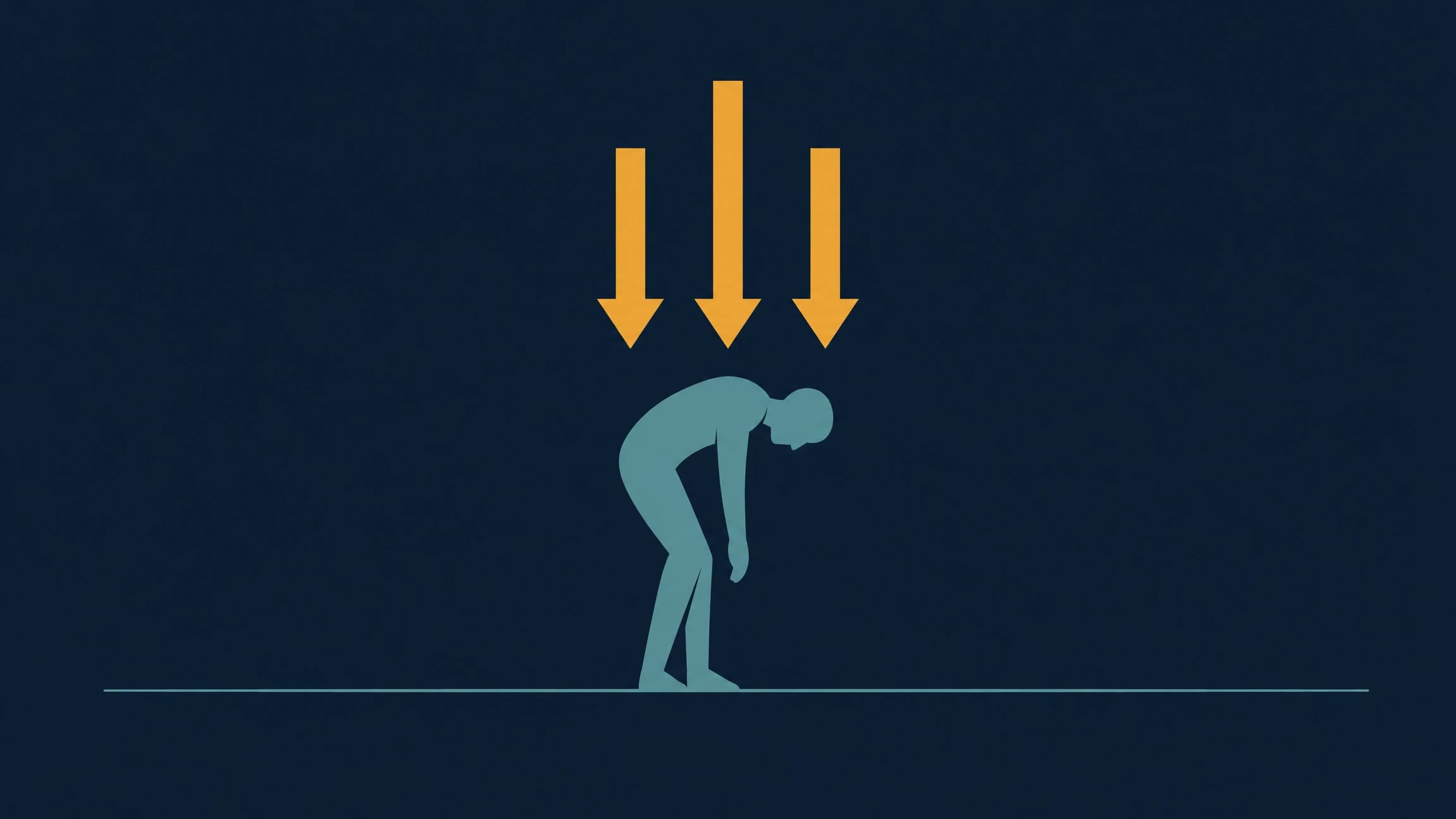
Minimalist editorial illustration of a person pressed down by doubled gravitational force
10 min readScience desk
Quick Answer

If the acceleration due to gravity at Earth's surface suddenly doubled from about 9.81 to 19.62 m/s², every object would experience twice its weight while its mass stayed the same. A 70 kg person would still have a mass of 70 kg, but would feel as if they weighed 140 kg. Walking, standing and pumping blood would become much harder; aircraft would need substantially more lift; and structures, vehicles and ecosystems would face loads far beyond their normal design conditions. The exact outcome depends on what causes gravity to double — a clean thought experiment assumes only surface gravity changes and leaves Earth's atmosphere, chemistry and size otherwise unchanged.

This scenario needs one clarification before the physics gets interesting: 'doubling gravity' most usefully means doubling the acceleration due to gravity at Earth's surface — roughly 19.6 m/s² instead of 9.8 m/s² — without changing anything else about the planet's chemistry or atmosphere. That is not a realistic event we know how to trigger, but it is a useful thought experiment because it isolates one variable that touches almost everything built or evolved around 1g.

The first thing you would notice: everything feels twice as heavy

Mass would not change. Weight would. A 70 kg person would still contain 70 kg of matter, but the downward force from gravity would double. In everyday terms, standing still would feel roughly like carrying an additional 70 kg all the time. Picking up objects, climbing stairs and simply accelerating your own body would require much more force.

9.81 m/s²
Current surface gravity
19.62 m/s²
Hypothetical gravity
140 kg
70 kg person's effective weight
+100%
Gravity increase

What happens to the human body?

The biggest immediate problem is not simply tired muscles. Blood has weight too, so the cardiovascular system would have to create a much larger pressure difference to move blood from the legs to the brain while standing. People would also put greater mechanical loads on their bones, joints and connective tissues. The exact survival threshold cannot be reduced to a single number because posture, fitness, body shape and the speed of the change all matter, but a sudden permanent 2g environment would be an extreme physiological shock.

Established science

A sustained 2g load is very different from briefly experiencing 2g during a vehicle manoeuvre, but aerospace medicine demonstrates the underlying principle clearly: increasing effective G-load makes it harder for the cardiovascular system to maintain adequate blood flow to the brain. The response depends strongly on duration, posture and individual physiology.

Would humans survive?

If gravity doubled instantly and stayed there, many people would struggle to stand or move normally, and vulnerable people could suffer serious cardiovascular and musculoskeletal consequences. Survival would not mean that every human dies immediately: some people could remain alive while largely bedridden, and technology could eventually help with mobility and circulation. Over generations, however, human bodies and infrastructure could adapt only gradually, through engineering, behaviour and potentially evolutionary change.

Why large animals would have a much bigger problem

The square-cube law makes body size especially important. As an animal gets larger, its mass and therefore its weight increase roughly with the cube of its dimensions, while the cross-sectional area of its supporting bones increases only with the square. That is one reason large terrestrial animals already face stronger structural constraints than small ones. Doubling gravity would push those constraints in the wrong direction immediately, especially for elephants and other very large animals.

Trees would struggle too

A tree has to support its own mass while moving water upward against gravity. Doubling gravity would increase the pressure needed to lift water through its vascular system and increase the mechanical load on trunks, branches and roots. The exact height limit would depend on species and soil conditions, so it is safer to say that very tall trees would become substantially harder to maintain than to claim that every tall tree would instantly collapse.

Buildings, bridges and infrastructure

A structure's own weight would double, as would the weight of people, vehicles, stored goods and other live loads. Existing safety factors are designed to provide margins against uncertainty and unusual loads, not to guarantee survival after a universal doubling of gravity. Some structures could remain standing; others, especially heavily loaded or already damaged structures, could fail. Engineers would have to inspect and reinforce infrastructure rather than assuming that a simple '2× gravity' multiplier predicts every failure.

Could cars and trains still work?

Cars would not suddenly become twice as massive, but their weight would double. Tyres would have to support more normal force, suspension components would carry larger loads, and braking would become more demanding. Frictional grip can increase with normal force, but so do stresses on tyres, axles and road surfaces. Trains would face similar structural and power challenges, while steep hills would become substantially harder to climb because the component of gravitational force opposing motion would be larger.

Advertisement
AdSense unit — in-article

Flight becomes much harder

Lift has to balance an aircraft's weight. If gravity doubles while the aircraft's mass stays the same, the aircraft needs roughly twice the lift just to maintain level flight. That could require greater speed, larger effective wing area or more engine thrust, all of which come with trade-offs. Helicopters and small aircraft would be particularly sensitive to the extra power demand, while birds and insects would face the same physics with biological muscles and wings.

What happens to the oceans and atmosphere?

The atmosphere would become more strongly bound to Earth in the sense that its scale height — a measure of how quickly pressure falls with altitude — would shrink if temperature and composition were held constant. The oceans would also experience a stronger gravitational pull toward the planet. But this would not mean that the oceans simply pile up at the bottom of the world: Earth remains a sphere, and gravity points toward its centre everywhere. The exact redistribution of air, water and climate would require a full atmospheric and ocean model rather than a simple cartoon prediction.

A timeline of the first year

Seconds

Every object's weight doubles. People feel an immediate increase in load on muscles, joints and the cardiovascular system.

Minutes

Movement becomes exhausting. Vehicles, machinery and structures begin operating far outside their normal loading assumptions.

Hours

Transport, construction and other heavy-load activities would be restricted while societies assess structural and medical risks.

Days

Food, water, transport and emergency planning would become major concerns, while engineers inspect critical infrastructure.

Months

Surviving systems would be redesigned around the new load. Large animals, tall vegetation and vulnerable infrastructure would face sustained pressure.

Years

If the new gravity remained permanent, technology and human behaviour could adapt, while biological evolution would only begin on much longer timescales.

Frequently asked questions

Would a 70 kg person weigh 140 kg?

Their mass would remain 70 kg, but their weight would double. Saying they 'weigh 140 kg' is a useful everyday shorthand for the force they would feel, not a literal change in mass.

Could planes still fly?

Some might, but they would need substantially more lift and therefore different operating conditions. Smaller and less powerful aircraft would generally be more vulnerable than aircraft with large lifting surfaces and excess power.

Would gravity crush the Earth itself?

Not in the simple thought experiment. We are stipulating that surface gravity doubles while the planet otherwise remains in place. A real physical mechanism capable of changing Earth's gravitational field would almost certainly alter other properties too, which is why the clean 2g scenario is a model rather than a realistic prediction.

Speculative

The exact pattern of structural failures, climate changes and long-term biological adaptation cannot be predicted from the 2g assumption alone. Those outcomes depend on how gravity changes, how quickly it happens, and how real materials, ecosystems and societies respond.

The bottom line

Doubling gravity would be less like one giant explosion and more like applying a permanent stress test to the entire planet. Human movement, circulation, transport, buildings, aircraft, animals and plants would all pay the price of the extra load. The most important lesson is that life and infrastructure are deeply calibrated to Earth's current 1g environment — and changing that single number would ripple through almost every system we take for granted.

A note on our approach: Every article on WhatIfLab separates what current science establishes from what remains genuinely speculative. Where we cite a figure or finding, it reflects published, mainstream research at the time of writing — not a prediction dressed up as fact.