Skip to content
WhatIfLab
EarthFILE 001

What If Earth Stopped Spinning?

Earth's equator is moving at roughly 1,670 kilometers per hour right now — faster than most commercial jets cruise. Stop that motion, even gradually, and almost nothing about life on this planet stays the same.

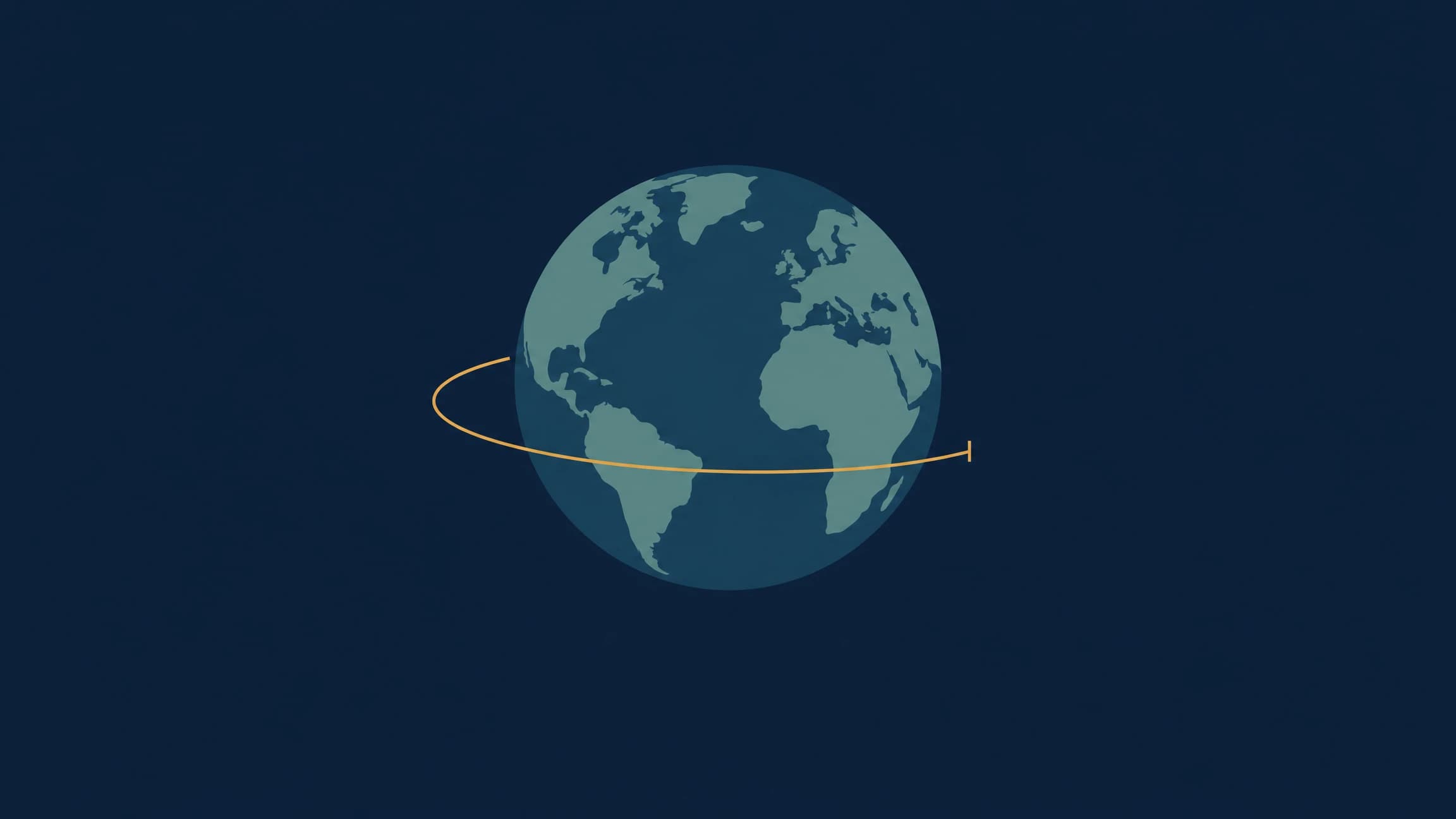
Minimalist editorial illustration of Earth with its rotation arc abruptly stopping
10 min readEarth desk
Quick Answer

It depends entirely on how fast Earth stopped. An instant stop is physically implausible but would be catastrophic — the atmosphere and oceans would initially keep moving relative to the surface, producing extreme winds and enormous waves. A gradual slowdown would be very different: the solar day could eventually stretch toward a year, with roughly six months of daylight and six months of darkness at many locations, while climate and ecosystems reorganized. The effect on Earth's magnetic field is much less certain and should not be treated as automatic.

Earth doesn't spin at a stately, imperceptible pace. At the equator, the planet's surface is moving eastward at about 1,670 km/h (1,040 mph) — faster than a Boeing 747 at cruise. Everything on the surface, including the atmosphere and the oceans, shares that momentum. That single fact is the key to understanding why stopping the spin, in any timeframe, is a genuinely dangerous idea.

Two very different scenarios

Physicists who entertain this question usually split it into two versions, because the outcome depends almost entirely on the deceleration timeline. An instantaneous stop is not something any known force could realistically cause — Earth's rotational angular momentum is enormous — but it's a useful thought experiment. A gradual stop, over millions of years, is closer to something that could plausibly happen through tidal braking, the same mechanism that has already slowed Earth's rotation over its history.

Established science

Tidal friction from the Moon is already slowing Earth's rotation by about 1.7 milliseconds per century. This is measured directly through changes in day length recorded by atomic clocks and confirmed independently by ancient eclipse records. It's the real-world mechanism scientists point to when modeling a 'gradual stop' scenario.

If it happened instantly

In the instant version, the ground would stop, but the atmosphere and oceans would not — momentum doesn't disappear just because the surface beneath it does. The result would be winds approaching that 1,670 km/h equatorial rotation speed, several times stronger than the strongest hurricanes on record, tearing across the surface as air and water 'kept going' relative to the now-stationary ground. Coastal regions would face tsunamis generated not by an earthquake but by the ocean's own momentum sloshing against newly stationary coastlines.

If it happened gradually

The slow version is less violent but arguably stranger to live through. As rotation slowed, the length of the solar day would stretch. If Earth eventually stopped rotating relative to the distant stars while continuing to orbit the Sun, the planet would no longer have a normal 24-hour cycle: most locations would experience roughly months of daylight followed by roughly months of darkness.

What would happen in the first 24 hours?

For an instantaneous stop, the first minutes would be catastrophic. The solid ground would decelerate, but the atmosphere and oceans would retain most of their eastward momentum. Near the equator, that relative motion starts at about 1,670 km/h. Air and water would rush across the surface, producing extreme winds, enormous waves, and widespread destruction. The exact pattern would depend on latitude, topography, ocean basins, and how the hypothetical force stopped the planet.

  • At the equator, the ground would lose roughly 465 m/s of rotational speed relative to the inertial frame.
  • The atmosphere would initially keep moving eastward relative to the newly stopped surface.
  • Ocean water would continue moving too, creating continent-scale flooding and destructive waves.
  • Objects not firmly attached to the ground would also continue moving until friction and collisions slowed them down.

A timeline of the hypothetical stop

0 seconds

In an instantaneous stop, the ground loses its rotational motion while the atmosphere, oceans, and unattached objects initially retain it. The relative motion would be devastating.

1 hour

Winds, waves, fires, debris, and structural failures would continue to reshape the surface. The exact pattern would depend strongly on latitude and geography.

24 hours

The immediate momentum-driven disaster would dominate the instant-stop scenario. In a gradual scenario, the changes would instead be subtle at first and accumulate over a very long period.

Years

If rotation were being slowed slowly, day and night would become progressively longer, forcing ecosystems, agriculture, weather patterns, and human infrastructure to adapt.

Long term

A non-rotating Earth would have a radically different climate and surface environment. The final state would depend on how the slowdown happened and how the atmosphere and oceans redistributed heat.

Would humans survive?

An instantaneous stop would be effectively unsurvivable for most people near the surface. The danger would not come from losing a mysterious 'centrifugal force' and suddenly being pulled into space; it would come from the enormous relative motion between the ground and everything that had been rotating with Earth. A gradual slowdown is different: humans could potentially adapt if it happened over an extremely long timescale, but agriculture, climate, ecosystems, infrastructure, and civilization would all face profound changes.

What would happen to the oceans?

Advertisement
AdSense unit — in-article

The oceans would be among the most visibly affected systems. In an instant-stop scenario, the water would continue moving while the seafloor and coastlines stopped, generating enormous surges and redistributing water across continents. In a slow-stop scenario, the effect is much subtler: Earth's rotation currently produces a small equatorial bulge, so removing rotation would allow the planet's shape and the long-term distribution of ocean water to adjust under gravity.

What would happen to the atmosphere?

The atmosphere would not simply stop because the ground did. In the instant scenario, its existing momentum would produce devastating winds relative to the surface. In the gradual scenario, circulation patterns would reorganize as the day-night cycle becomes radically longer. The result would be a climate system unlike today's, with much stronger contrasts between prolonged heating and prolonged cooling.

The magnetic field problem

Earth's magnetic field is generated by the geodynamo — convection and motion of electrically conducting liquid iron in the outer core. Rotation helps organize the flow, but it is not accurate to say that stopping the surface rotation would automatically switch the magnetic field off. A sufficiently large change in core dynamics could alter the field over long timescales, but exactly how much it would weaken in a hypothetical non-rotating Earth is uncertain. The magnetic field matters because it deflects much of the charged-particle flow from the Sun and helps protect Earth's near-space environment.

Speculative

How much the magnetic field would weaken, and how quickly atmospheric loss would follow, is genuinely uncertain — it depends on core dynamics that are still active areas of geophysical research. Mars offers a comparison, not a precise prediction, since its core and history differ from Earth's in ways scientists haven't fully mapped.

1,670 km/h
Equatorial rotation speed
+1.7 ms / century
Current day-length change
~6 months each
Hypothetical day/night cycle
~0.35%
Equatorial gravity increase if rotation vanished

Would the Sun still rise and set?

Yes — but not every 24 hours. Earth would still orbit the Sun, so the Sun would continue to move across the sky because of Earth's orbital motion. If the planet stopped rotating completely relative to the stars, a location would spend roughly half an orbit facing the Sun and roughly half facing away from it: about six months of daylight followed by about six months of night, with important differences by latitude and season.

Would gravity change?

A little. Earth's rotation slightly reduces the effective weight felt at the surface, especially at the equator. Remove that rotation and effective gravity at the equator would increase by roughly 0.35%. You would weigh a little more, but this effect would be tiny compared with the atmospheric, oceanic, and climate consequences of stopping the planet.

Frequently asked questions

Would Earth be thrown out of orbit? No. Earth's rotation and its orbit around the Sun are separate motions. Stopping the spin would not, by itself, remove Earth's orbital velocity. Would we all fly into space? No. The immediate problem is the opposite: the surface would stop while the atmosphere, oceans, and objects retain their momentum. Would the whole planet freeze? Not instantly. Climate would reorganize over time, and the final temperatures would depend on atmosphere, oceans, geography, and how quickly rotation was lost.

This scenario also connects directly to several other WhatIfLab questions: removing the Moon would alter tides and Earth's long-term rotational evolution, while doubling gravity would show how sensitive life and infrastructure are to changes in Earth's physical environment.

The bottom line

Earth's spin isn't a background detail — it's load-bearing infrastructure for the climate system, the magnetic shield, and the day-night cycle every organism on the planet evolved around. Losing it instantly would be catastrophic on contact; losing it gradually would reshape the planet into something closer to Mercury or the tidally locked exoplanets astronomers now find throughout the galaxy. Either way, the 'gentle slowdown' most people imagine when they hear this question isn't really on the table.

A note on our approach: Every article on WhatIfLab separates what current science establishes from what remains genuinely speculative. Where we cite a figure or finding, it reflects published, mainstream research at the time of writing — not a prediction dressed up as fact.